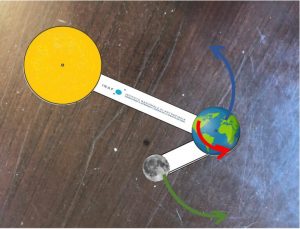
 This simple activity, designed for pre-school children, or children in the early years of primary school, allows us to bring the little ones closer to understanding the motions of familiar celestial bodies, such as the Sun, the Earth and the Moon. Through the construction of a bidimensional model (2D), not to scale, children will be able to familiarize with the movements of the Moon around the Earth, and of the Earth around the Sun, making learning these concepts more concrete and fun. The yield is better if the Sun-Earth-Moon model is printed on cardboard. As an alternative, you can print it on normal paper and glue the sheet onto a piece of cardboard before cutting and assembling.
Necessary Material:
- A4 copy of the sheet Sun-Earth-Moon model (better if printed on cardboard)
- (optional) glue
- Scissors with rounded tip
- 2 paper clips or sample holders
- nail or toothpick
- colored pencils, brushes, or markers
- possible cardboard
What to do
- Download the file Instructions for the Sun-Earth-Moon model with all the details.
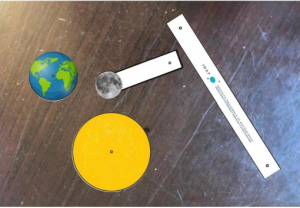
How to build the model
- Print the sheet with the Sun-Earth-Moon model, on A4 paper (better if printed on cardboard)
- Colour the disk of the Sun, the one of the Earth and Moon
- Use your scissors to cut each piece along the outer solid line
- Use a nail to drill the small circles, or another sharp object, such as the tip of a pencil, or a toothpick (attention: they need the help of an adult)
- Insert the paper clip in the hole in the center of the Sun, then add one end of the connecting rod and secure everything, folding the sample-holder’s tabs.
- Insert the second clip in the hole at the center of the Earth, then add the end of the Moon’s rod, and, finally, the other end of the long rod, still connected to the Sun, and fold all the tabs of the sample-holder.
Notes on the Activity
If you print the model on a A4 sheet rather than on cardboard. Make sure they distribute the glue evenly on the whole sheet of the model before gluing it on the cardboard.
Children may colour Sun, Earth and Moon even after cutting out the various shapes.
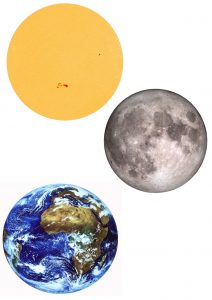
When you draw the Earth, there is much to learn about the geography of our planet, not only the shapes of the continents, but also the reason why some areas have lots of green, whereas others are brown, and others are blue, or white.
When you draw the Moon, you should take into account the features of its surface when the Moon is full.
When you draw the Sun, you should take into account the features of the solar surface, with its black spots.
Be careful that the Sun remains fixed: it is the centre of our solar system. The Earth must rotate around the Sun, and not viceversa!
Questions for children:
• The Moon revolves around which object?
• The Earth rotates around which object?
• Which side of the Earth is illuminated?
• Why is there night?
• How long does it take the Earth to rotate?
• How long does it take the Earth to orbit around the Sun?
• How long does it take the Moon to orbit around the Earth?
EARTH’S ROTATION
The Earth rotates around its own axis in 24 hours: this is the definition of a day. On the side of the Earth facing the Sun, it is daytime, whereas on the other side it is nighttime.
EARTH’S REVOLUTION AROUND THE SUN
The movement of the Earth around the Sun is called revolution. Let us say then that the Earth orbit around the Sun. The Earth rotates around the Sun in 365 days and 6 hours: this is the definition of a year.
If you want to move the model with the real time-scale, we should make the Earth rotate 365 times around its own axis duraing a orbit around the Sun!
MOON’S REVOLUTION AROUND THE EARTH
The Moon orbits around the Earth completes its revolution in 27,3 days.
Please note that the model is not to scale.
Guarda Paxi – Il giorno, la notte e le stagioni dell’Agenzia Spaziale Europea – ESA.
This activity is taken from the resources of Fédération des astronomes amateurs du Québec