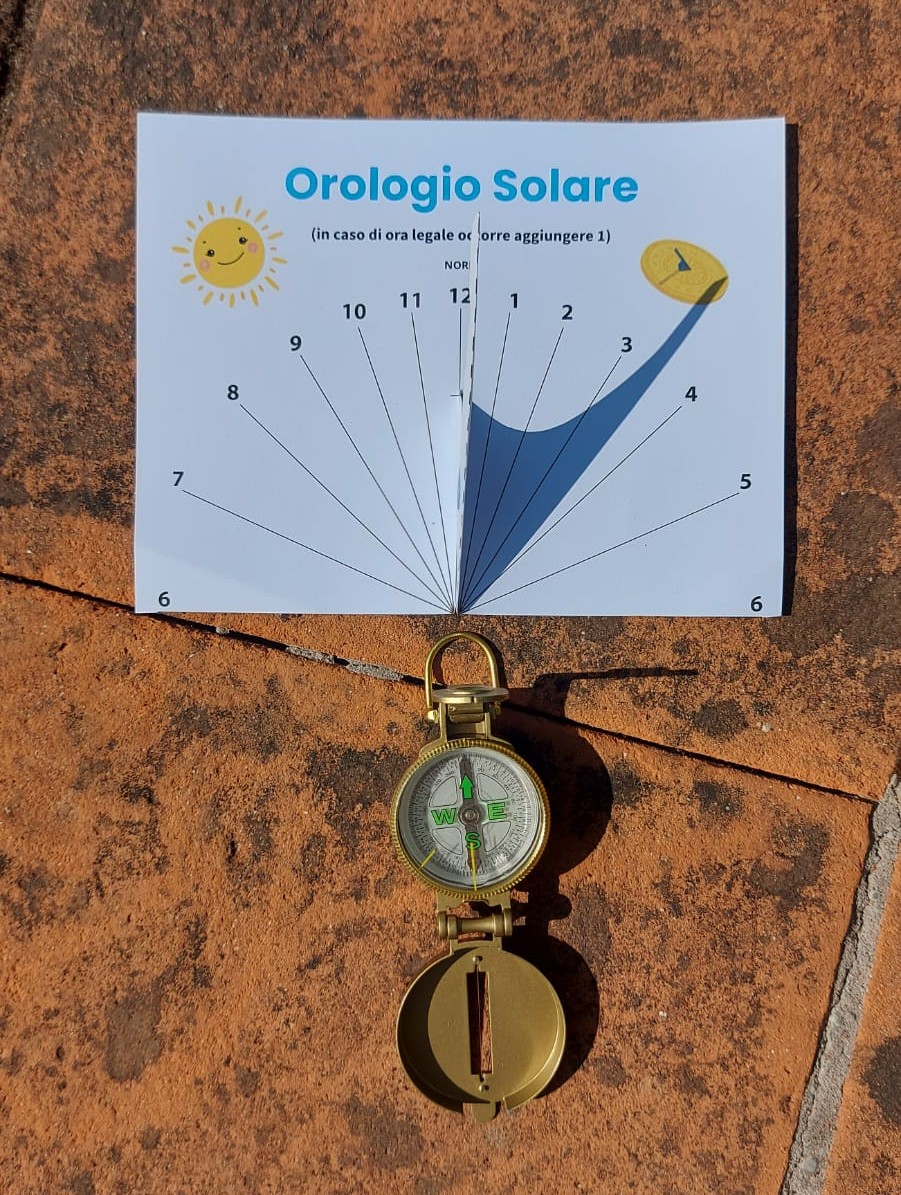
With this activity you can quickly build your own paper sundial and find out what time it is by using the Sun! The performance is better if the watch pattern is printed on a cardboard. As an alternative, you can print it on normal paper and glue the sheet on a cardboard, or a file folder, before cutting and assembling.
Necessary Materials
- Copy of the sheet Sundial (better if printed on cardboard)
- Scissors
- Tape (Scotch tape)
- (optional) file folder
- (optional) glue stick
What to do and how to observe
Read the instructions to familiarize yourself with the process.
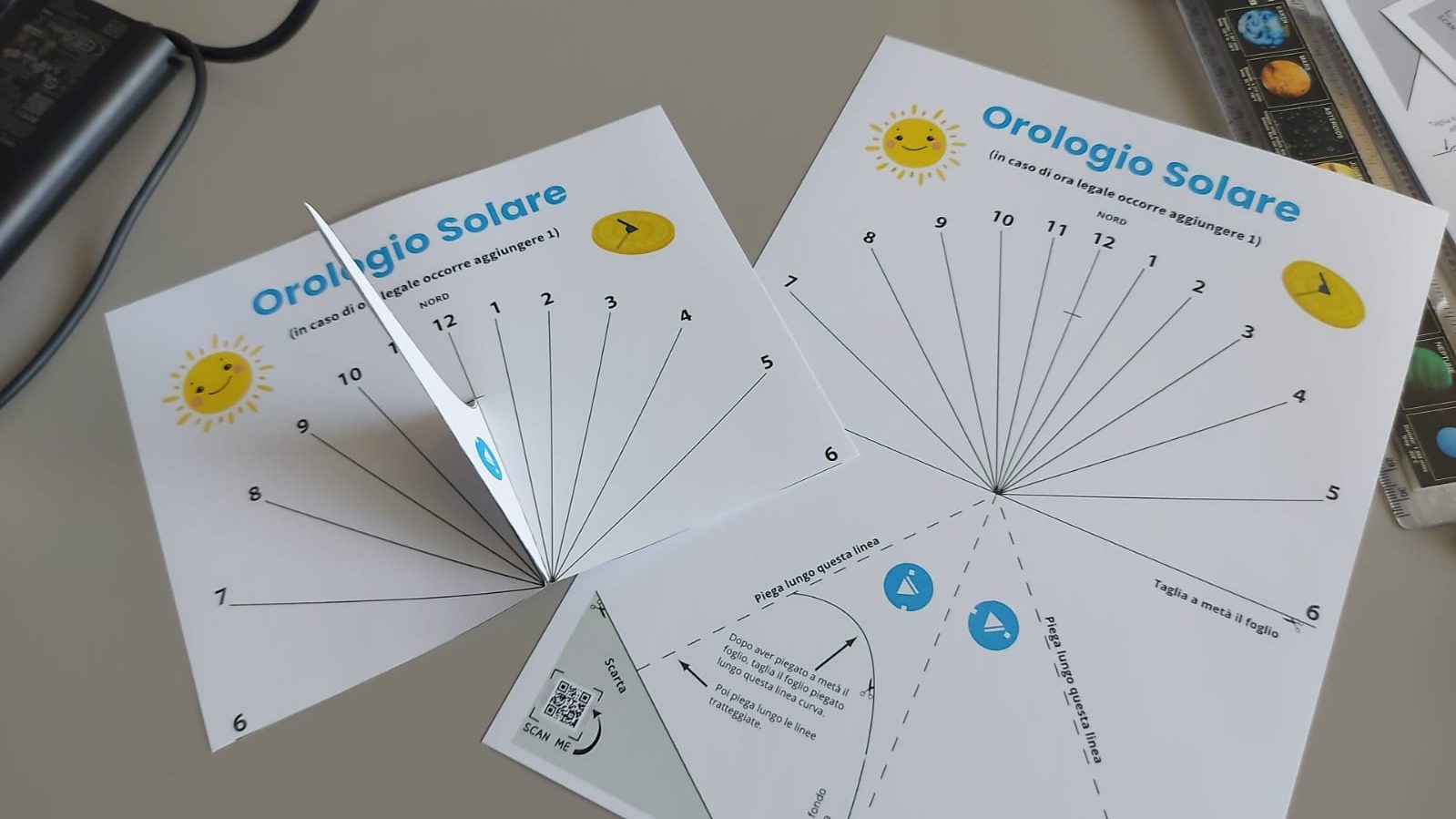
- Cut out half of the sheet along the solid line.
- Take the sheet with the hours and cut carefully along the central line (corresponding to 12) only up to the horizontal bar, about 2/3 of the height. Do not cut more than this!
- On the other half of the sheet, the one with, the gnomon (that part of the sundial which projects its shadow on the plate of the solar clock), cut the corners and discard them. Then fold the gnomon in half along the dotted line, so that the curved line is outside. While holding it folded, cut along the curved line, and keep cutting to the edge of the sheet. Do not cut along the dotted lines!
- Fold along the dotted lines in the opposite direction to the original central fold, as if they were the wings of a paper airplane. The “wings” should be flat on the table and the gnomon should rise perpendicular, like a shark’s finn.
- Insert the gnomon in the slot on the base with the watch, with the high, thin tip facing towards “12”, to ensure they are well aligned. Turn it and tape the gnomon firmly to the base.
Notes on the activity
It is important to keep the gnomon perpendicular to the base and make the bends as precisely as possible. You also need to know where the north is. Once you have completed the sundial, orient the tip of the gnomon (or the top of the base) northward, while keeping the base parallel to the ground. Compare the time indicated by the sundial with your watch, to see whether the “instrument” you have realized is precise! Now you can use it to read the time, of course only when the Sun is shining … for example on the beach, during a hot summer day. Pay attention: if daylight saving time is in effect, you will need to correct the time you read by adding “one”.
 This activity is an adaption of the NASA project “Solar Clock“. The inclination of the gnomon should be changed from the original project, so as to take in account the latitude of the place.
Further info:
- Download the file Sundiala [instructions] with detailed instructions.