Teaching activity planned by Edoardo Ceccarelli, Giulia Campitiello and Stefano Sotira during the PhD course “ Designing innovative public engagement activities” at the University of Bologna in 2023.
Short description of the activity:
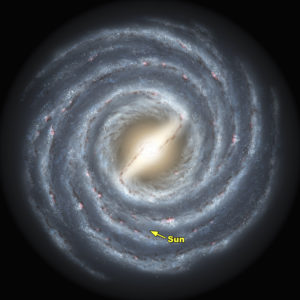
The Universe is mainly composed of a series of structures which are called galaxies, of various shape and kind. The galaxy in which we live, or hosts our Solar System, is called Milky Way and is one of the many spiral galaxies. The name of this category of objects derives from the particular distribution of gas inside, which takes the shape of a spiral.
The goal of this activiy is discovering what spiral galaxies are like through the construction of a tridimensional model.
 Materials
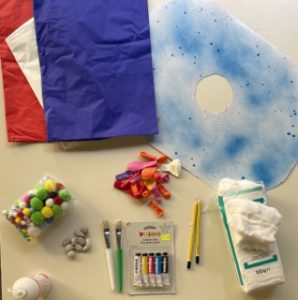
- Thick blue elliptical card with a hole in the middle (as in the image on the right), to represent the disk of the galaxy on which the other elements will be glued
- Cotton wool to reproduce the arms of the galaxy
- Red/blue and white/yellow tissue paper to create stars (as an alternative, you can si use clay loin or fabric balls)
- Red balloon to create the nucleus of the galaxy
- Stone to be inserted inside the balloon to represent the black hole in the centre of the galaxy
- Vinyl glue
- Tempera colours and brushes (to colour the clay or add details to the model)
- Pencils or pens
- Supporting slides (printed or projected: you can download them here)
Preparing the activity
Before starting, prepare the blue cards which will form the base of the galaxy. There is no recommended size: the main thing is that the card should be thick enough to support all the other elements which will be glued over it.
Place the material on the table, so that it is tidy and easily accessible during the whole activity.
The minimum age suggested for participation is 8 years.
Description of the activity
Introduction
Use the support slides to take a short trip inside the Milky Way and its components, encouraging a collective discussion rather than an explanation.
To encourage interaction, you can make questions, such as: “What do you think the Universe is made of? What galaxy are we in? What do you think our galaxy look like? What is it made of?”
If you want to explain the composition of the Universe , you can use a metaphor: if we imagine the Universe as a big city, the houses are the galaxies, whereas the bricks they are made of are the stars, the gas and all the material inside them.
Spiral galaxies are a type of galaxies: their name comes from the distribution of the material along the arms of a giant spiral.
- disk (represented by the card): rich in gas and stars, mainly blue and very thin;
- nucleus (represented by the balloon placed at the centre of the disk): it is a red spherical/elliptical structure, composed by red stars, and deprived of gas
- arms: composed of gas clouds (represented by cotton wool) and more stars, in comparison with the disk. Inside them, new stars are born
- stars (represented by balls of clay or tissue paper): they are blue, red or yellow/white of various sizes, and can be found both on the disk and on the arms;
- black hole (represented by the stone to be inserted in the balloon): it is placed at the centre of the galaxy, inside the nucleus. Inside a galaxy, there may be different black holes, but the central one is the most massive, namely the one having the highest gravity
Building the model
Once we have concluded the introduction, we proceed with the model. The choice of materials to be used to represent each component can be made together with the public, reasoning on the better one (for example, cotton wool well represents the gas clouds of the arms, the balls of clay/tissue paper are suitable for the stars, etc.).
We suggest that you follow this pattern:
- draw on the disk (the card) the contours of the arms of the galaxy, following the example in the slides
- distribute vinyl glue inside the previously drawn arms
- paste the cotton
- form balls of tissue paper/clay and glue them on both cotton and card
- insert a stone inside the balloon, inflate it and then fit it into the hole at the center of the card
- you can add a yellow star, distinguishable from the others in the peripheral area of the arms, to represent the Sun
- the same can be done with small black balls glued on the disk and/or arms to represent the other black holes

Explanation of the physical process
Galaxies are the main components of the Universe. We can imagine them as many houses making up a city. In the case of spiral galaxies, so called because of the particular shape taken by the material inside them, bricks are the disk of blue stars and gas, the nucleus of red stars, the black hole inside, the arms of gas clouds and stars.
The colour of stars depends both on temperature and age: blue stars are the youngest and hottest, whereas red stars are the oldest and coldest ones. In between, we can place yellow and white stars. Our Sun, for example, is a yellow star.
Le stars contained inside spiral galaxies were mainly born in the arms: here the density of gas is so high that favors the triggering of nuclear reactions which keep stars alive.
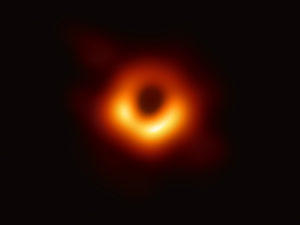
When a large massive star runs out of material to burn inside, collapses on its own, and contains a lot of material in a very little space. The object formed, called black hole, has such a high gravity, that it captures anything that passes by, including light. That is why they are called black holes: from our perspective, we observe them as dark holes in the sky, but they are in any case spherical objects.
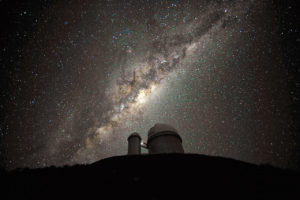
The spiral galaxy to which our Solar System belongs is called Milky Way: from the ground we see it as a strip in the sky. The Sun is placed in Orion arm, in a peripheral area, which allows us to observe the numerous objects in the galaxy, without being disturbed by the huge luminosity of the nucleus. In particular, the Northern Hemisphere aims outside the galaxy, while the Southern hemisphere towards the galactic centre.