Teaching Activity planned by Ilaria Viale and Marco Dall’Amico during the PhD course “Designing innovative public engagement activities”, held at the University of Padova in 2022.
Astrophysical Box:
The goal of this laboratory is to show children how astronomers observe black holes. In this activity we will show the effect of gravity exerted by different bodies in a small region of spacetime, reproduced by a black sheet held taut on a hula hop. We will simulate the deformation of spacetime through the deformation of the sheet, due to the different masses of bodies used. We will start from lighter bodies to show smaller gravitational effects, and will gradually increase the masses, until we show the extreme gravity exerted by a black hole (heavier mass). Finally, thanks to the help of tempera, we will show children how black holes capture the surrounding matter, by reproducing the well-known image of the black hole M87*. The whole thing is introduced as an interactive activity, so that children may experience these concepts first-hand, impersonating the work of the astronomer.
Materials:
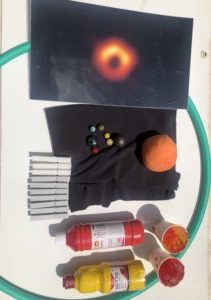
- Yellow/Orange/Red Water Tempera
- A colour photo of M87 (if possible in A3 format)
- ~30-50 recyclable paper cups
- 1-2 garbage bags
- 2 x hula hoop (those for rhythmic gymnastics perfetti)
- About 40 Clothespins (if you have office paper clips, that is even better)
- Two black elastic 1m x 1m sheets
- A small heavy ball, possibly 800-1000 g.; if it is small, that is better (a gym weight will do)
- A 300 gr. ball (a beach bowl can be an example)
- Marbles of various colors and sizes
- Kitchen paper for children to clean their hands
- Scissors (optional)
- 1 pack disposable gloves (optional)
Preparation of the activity:
The activity is designed for two groups of about 7-8 children. Each group will work in parallel on a hula-hop, following the same instructions below.
- 1. Lay the black cloth on each of the two hula hoop and start to secure it with clamps. This will be our Universe, space. If the cloth is elastic enough, we can stretch it enough. On the other hand, is the cloth is too stiff, we can leave it a little softer, while being careful not to leave lumps.
- 2. Prepare aprons for the children (we will need them when they use paints to avoid getting their hands dirty): we will take the garbage bags and make one hole for the head and two holes for the arms.
Description of the activity:
Once we have built our Universe simulator with hula hop and cloth, we can show children how different masses have different effects on the cloth. We can take marbles of different sizes, and show them how they deform the cloth in a different way is they are left still (the heavier ones will provoke a greater deformation) and how they behave if we make them launch. We can also use the 300 gram-balls as example of the Sun, put it in the middle and encourage children to throw lighter marbles around it, so that they start orbiting around it.
Let us replace the Sun-marble with the heavier ball (our black hole) and repeat the experiment, while observing that the deformation of the cloth is greater, and, as a consequence, the effects of gravity upon the other marbles are stronger: the marbles fall down more quickly into the black hole. The gravity of a black hole is so powerful that it even captures light. Indeed, light falling inside a black hole does not manage to come out of it: that is why the black hole is black: not only does it not emit light, but it also captures it.
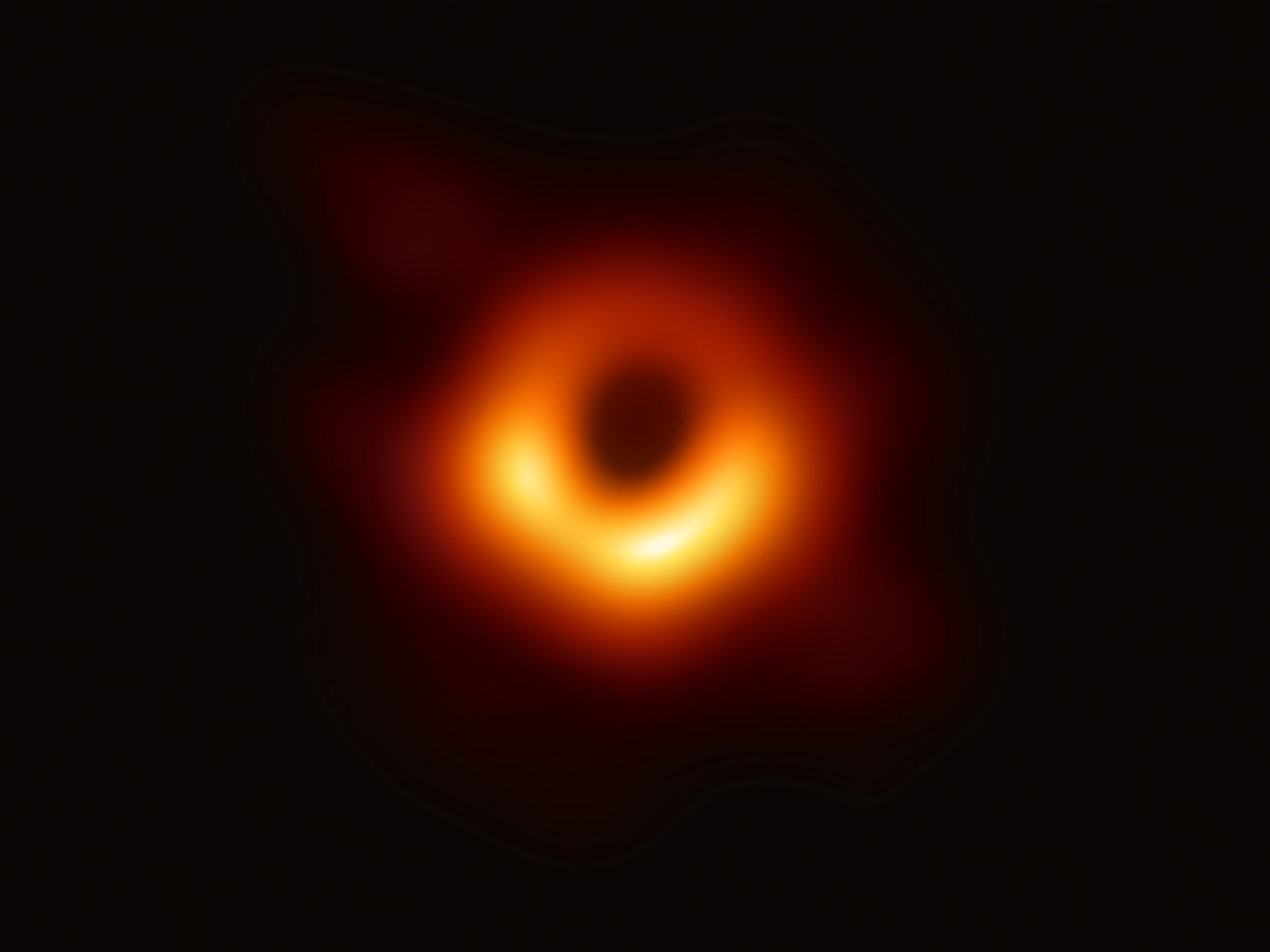
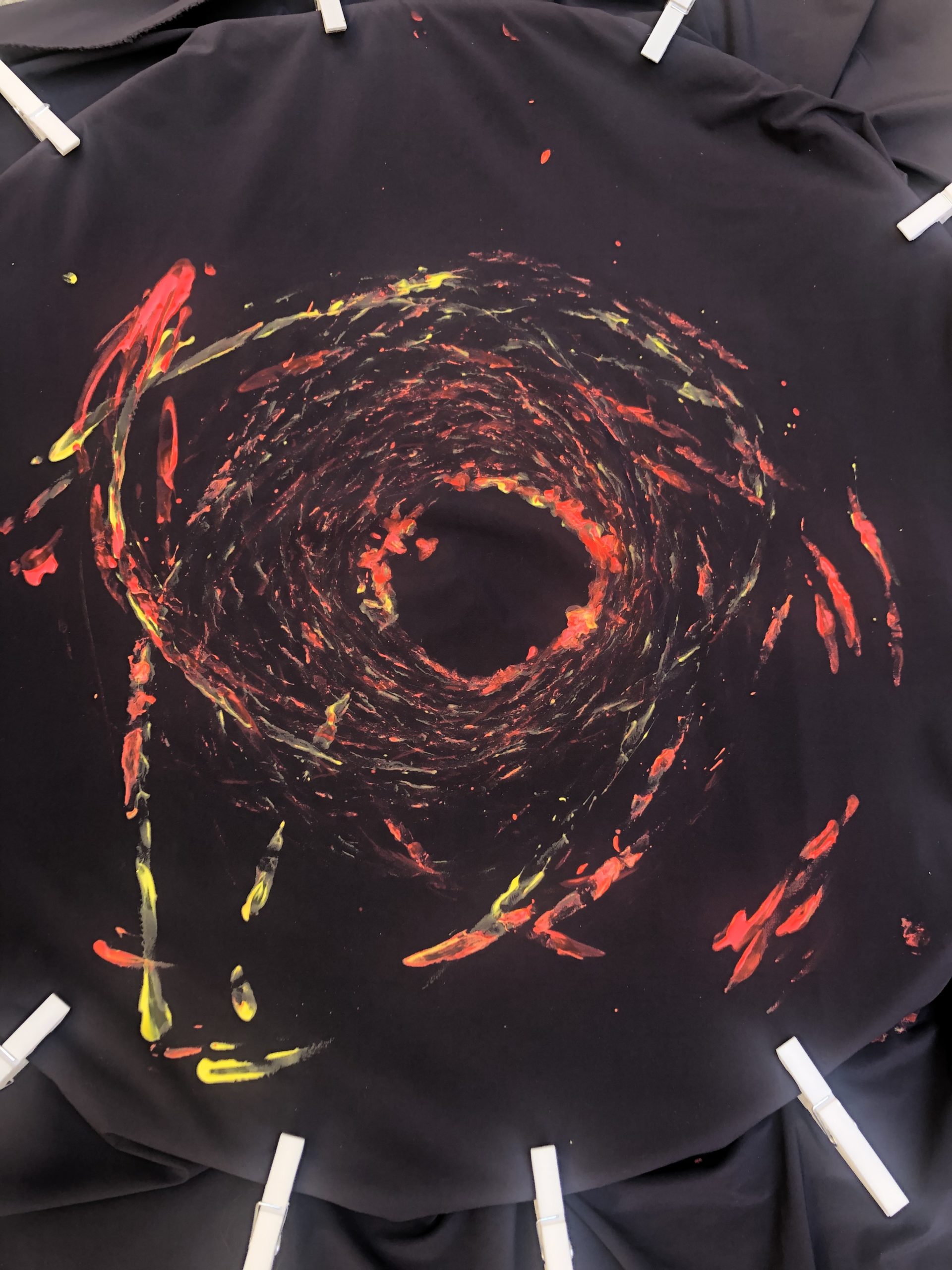
However, astronomers failed to “photograph” a black hole. In order to take a photo of an object which does not emit light have exploited the fact that, when matter falls into the black hole (in the earlier case, the marbles which were being thrown, namely stars, planets and asteroids) emits radiation. In order to reproduce this experiment, let the children wear the previously prepared aprons, give them glasses with tempera paints, and let them dip a marble in them. While holding the heavier mass at the centre of the cloth, let the children repeat launches with balls impregnated with colour. We’ll see that they will leave coloured trails along their trajectories. As children throw the marbles, the cloth should become more and more colored, and a spiral pattern should form around the black hole. This is the accretion disk around the black hole, and this is the opportunity the astronomers took to take their first picture of the black hole M87*.
Finally, let us compare the original picture made by astronomers with the drawing obtained with tempera paints, and notice similarity:
Description of the physical process:
Black holes do not emit light because of their extreme gravity. In order to observe them, astronomers take advantage of the light emitted by the matter surrounding the black hole, which creates a contrast with the background, and with the black hole itself, thus allowing to indirectly observe the black hole, through its shadow upon the surrounding light. This orbiting matter around the black hole is called accretion disk, and is composed of a hot gas called plasma. Plasma rotates around the black hole at different speed, with the innermost layers rotating at a higher speed then the outer layers (like the planets of the Solar System: Neptune rotates more slowly than Mercury). This difference in speed causes the different layers to “streak” on each other, generating friction. Because of this friction, plasma heats up and emits light, which we can observe with our telescopes. With this technique, the astronomers of the Event Horizon Telescope managed for the first time in 2019 to observe the supermassive black hole at the centre of the M87 galaxy, about 52 millions light years away from the Earth. The picture was taken thanks to the observation of various radio-telescopes all over the world, and copied here below. In the picture, the disc around the black hole appears brighter on one side because of its orientation with respect to the Earth. The brighter side of the disk is the one rotating towards the Earth, whereas the darker side rotates in the opposite direction. This adds intensity to the light emitted by side rotatijg towards us.