Teaching Activity designed by Irene Salmaso and Erika Korb during the doctorate course “Designing multi-sensory public engagement activities”, held at the University of Padova in 2025.
Short description of the activity
This lab is aimed at raising awareness on causes and effects of the progressive disappearance of darkness in our sky. Participants will discover that the increase of artificial light produces negative effects both upon Astronomy and the ecosystems. The activity will start with a journey from the city centre to the Atacama desert, during which participants will be able to see first-hand the change in the number of stars you can see in skies which can be polluted in various ways. Afterwards, participants will experience first-hand the astronomers’ difficulties in sifting useful information from the irrelevant noise. They will try to use the information collected in order to lear something about darkness, and orient themselves like a nocturnal animal. Finally, we will discuss the causes for light pollution and the actions to be taken to reduce it.
Necessary Materials
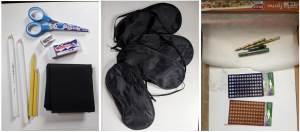
Here are the materials we need to carry out the activity (Figure 1):
- Black cardboard
- Baking paper
- Staples or glue
- Pearls, glue or glitter
- (optional) printed image of the Milky Way, and of a recognizable architecture element, for example a tower, to help immersion
- White and yellow pencils, or paints and brushes
- Rubber, penknife and scissors
- Bandage or sleep mask
- 3 facts about darkness, chosen from a list on the basis of the audience age (see appendix)
Preparation of the activity
Before the start of the activity, you need to prepare the hard copy to simulate the effect of light pollution on a starry sky.
In order to create the sky vault, there are two possibilities:
- Print a picture of the Milky Way and glue it on a cardboard;
- draw the Milky Way on a black cardboard with paints and coloured pencils.
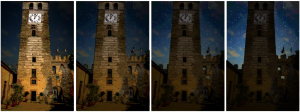
InIn both cases, we suggest that you add glitter, small pearls or stickers to the drawing, in particular on the path of the Milky Way, so as to make it more evident and easy to recognize, even by touch. Now you just have to staple or glue a few sheets of baking paper on one of the short sides of the cardboard to obtain different shades of polluted sky.
Here too, there are two possibilities (Figure 2):
- cut up all the sheets of baking paper of the same size of the cardboard, and overlay them;
- cut up each layer slightly shorter than the other one.
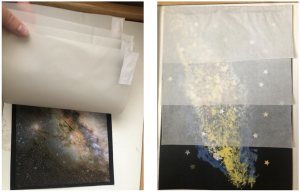
In order to make the scenario more realistic, we suggest that you add, on the edge of the baking paper layer, an architectural element of the town (for instance the tower of Figurw 3), taking care to darken it as you get closer to darker areas (i.e. less polluted from the point of view of light).
Description of the activity
The activity takes place in five macro-phases. In the first three phases, participants will experience:
- a (simulated) journey from the city’s polluted sky to the desert sky
- the difficult search for information hidden in a polluted environment
- the disorientation of nocturnal animals, in an alternative version of blindman’s bluff
In the end, There will be a discussion to reflect on what we can do in order to reduce light pollution. Finally, younger children will be able to unleash their creativity and draw a starry sky on a black cardboard, which they will bring home, with the opportunity to add a layer of baking paper, so as to remember the effects of light pollution.
Phase 1: Travelling towards darkness
The activity starts while asking participants what springs to mind when they hear the word “darkness”. Does this word give them positive or negative sensations? Are they afraid of darkness, or were they afraid as small children?
Later on, you should ask them whether they ever heard about light pollution. Ask them to try and describe its effects and speculate whether this is an overall phenomenon, or whether it takes place in specific places only. Their theories are tested, following the scientific method. Since the activity takes place in daylight, you cannot make direct observations. Rather, you need to simulate a night sky. Therefore, you should use the hard copy you had made earlier, and they start to tell the story of a journey. The adventure will start by night in a city centre, and the support will present all the layers of baking paper, preventing you from seeing the sky below. You will ask participants to say how many stars they see or feel (by touching the support); it is likely they do not seed or hear much, just because of city lights (represented by various sheets of baking paper overlapping). While browsing the first page, you travel from to city to a small village. Make them notice how the hallmark they have chosen is in the bottom corner of each sheet. Ask once again participants whether they now see or hear stars. Here they should see/hear more stars. Later on, they remove another layer of baking and you move to the open countryside, where there are only a few scattered houses, and roads and repeat the test. With the next sheet, you move to a remote area, like a mountain wood, where lights are far away and confined to the valley floor. Finally, when lifting the last layer, you can see the sky from a place like the Atacama desert, where the world’s largest telescopes are placed.
Phase 2: What does pollution mean?
Therefore, we have understood that light pollution prevents us from seeing the stars, apart from the brightest ones. This is a problem, not only because part of this natural heritage is not accessible to us, but also because it causes difficulties to the work of astronomers, who get a lot of informations from the stars.
In this phase, we will choose three “facts about darkness” from the list in appendix, one of which must necessarily be the “necessary fact”.
- You choose two volunteers from the public, a reader and a receiver, and place them a fewfew metres away. The reader will have to read the fact which has been given to him (or you can make him/her draw it), and the receiver will have to repeat what he hears in his/her own words. The first time, you ask other participants to remain in silence. In this way, the information will be completely transmitted.
- The second time (you can change both reader and receiver at each turn, so that all participants can try it), ask the rest of the participants to whisper/talk with each other in a normal tone of voice (depending on whether the activity takes place indoors or outdoors). At this stage, the information should pass in incomplete form, or with a great effort on the part of the receiver, who should concentrate a lot to hear the words of the readers.
- The third time, you should give the reader the “necessary fact”, and ask participants to shout and clap hands. The receiver will understand nothing. In the end, one of the facilitators of the lab will read the message to all participants.
At this point you can make a few considerations: if the reader reads with a particularly high or low tone of voice can facilitate or make more difficult the receiver’s task. This is similar to what happens in Astronomy when you have a more or less brilliant star, which can be more or less difficult to identify and observe. Moreover, if the receiver makes a greater effort in order to understand the message (for example, leaning out with his/her ear towards the reader), he/she may glean more information even in a moderately noisy environment, just as a more powerful instrument or a larger telescope allow to collect more light even from weak stars. In general, however, we understand that when there is more noise, i.e. more light pollution, it is much more difficult to get information from the stars.
Phase 3: How to navigate in the dark
The last fact we have read revealed that many animals navigate in the dark thanks to the Moon and the stars, but can often be diverted by city lights.
- In this phase, which takes place in turns like the preceding one, one participant will play the role of the Moon, and the other of the moth seeking to orient itself. Once again, volunteers will be placed a few metres away, the moth is made to bandage and gently turn on his/her-self, so they he/she loses their bearings. The Moon must guide the moth to herself, giving simple commands, such as “turn left”, “go ahead”, etc. At the first stage, all the other participants are silent and far away, so that the moth easily reaches the Moon.
- At the second stage, one/two further volunteers will act as streetlights (and the roles of Moon and moth can be changed if there are many participants) who will be distributed between the Moon and the moth and will try to attract the moth to them, using the same indications of the Moon. At this stage, the moth should – in any case – manage to find the Moon, particularly if he/she knows the person, or if the volunteers have very different voices, but will nonetheless struggle more than before.
- Finally, they all group together and become streetlights, everyone trying to divert the moth. According to the number of participants, this stage can be very difficult, and almost surely the moth will end up against a streetlight.
We can now ask the public a few questions in order to encourage reflection. In particular, we can ask to those who played the role of mole: “Did you like losing your bearings?”, “What did yiou feel while you were looking for the Moon?”, and so on.
With this last activity, we realized that light pollution is harmful for the environment too, therefore what can we do to reduce it?
Phase 4: What can we do to decrease light pollution?
Ask participants this question and listen to their answers. For any suggestion, even if it is considered invalid, always answer a positive manner (“interesting idea” and things like that), so as to encourage dialogue. In case, propose a similar, but more feasible, alternative. For example, a suggestion might be – “Let us no longer use electricity”, which can be corrected by saying “Good idea, but in that case we would see nothing anymore and would risk getting hurt moving at night. However, we might think of closing the blinds or lowering the shutters when it is dark, so that light coming from our windows is not visible outside”.
Here are further good practices:
- Turn off the light when you leave a room;
- Install motion sensors for the outdoor lights, so that they turn on only when a person passes nearby;
- prefer bulbs with fixed wavelength, so that they do not get in the way of other wavelengths;
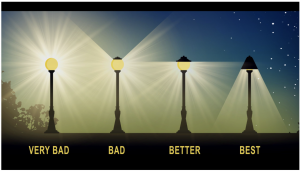
- plan shielded lamps and streetlights, which direct light only downwards, as shown in Figure 4 (here you can point out the shape of the streetlights in their surroundings; if they are round-shaped, this means that they emit light in all directions, thus polluting the night sky).
In case good practices are not provided spontaneously by the public, facilitators can propose them.
Phase 5: Let’s build the dark sky
For those who want it, the lab can end with a manual activity, in which participants build a model of the sky with various layers of light pollution, to carry home, similar to the one shown at the start.
Participants may paint or draw stars on a black cardboard, place stickers and so on, thus creating their own version of the starry sky. Later on, cutting up three strips of baking paper, they will reproduce the effect of light pollution. While bringing the cardboard, participants will remember this experience and will explain the problem of light pollution to their families.
Description of the physical process
When we think about pollution, smog, plastic or contaminated water immediately comes to mind. However, there is a more silent and often undervalued form of pollution: i.e. light pollution. It consists of the excessive or wrong diffusion of artificial light during nighttime, an ever-increasing phenomenon with the expansion of cities and human activities.
Public lighting is necessary because of safety and functionality, but, unless it is planned correctly, it may have significant consequences upon various aspects of our life and the environment. Light pollution is a scientific, ecological and health problem.
Astronomy is the area most affected by light pollution. The artificial light scattering upwards is diffused by particles in the atmosphere, thus creating a sort of pale halo covering the weakest stars. This phenomenon takes its name – skyglow. For example, in a big city you can see with a naked eye only a few dozens stars, whereas in a dark place, far from light sources, thousands of stars would be visible. This makes amateur observation, but also scientific research much more difficult: telescopes must be places in isolatea area, at a large distance from urban areas, as on top of a mountain or in the desert.
Moreover, light pollution can have negative effects also upon human health. Indeed, all our body functions are governed by an internal clock called circadian rhythm, which follows the 24-hour dark-light natural cycle. During the night, in the darkness, the brain produces melatonin – a hormone which is fundamental for sleep and for various other biological processes. The exposure to artificial light during the nighttime (for example because of lighs entering from the windows or lit screens) can inhibit the production of melatonin, thus causing sleep disorders, chronic fatigue and in some cases, contributing to the emergence of more serious problems, such as depression or metabolic alterations. A few studies, which are still being studies in depth, also suggest possible links with cardiovascular and tumour diseases, even though these assumptions must be evaluated with caution.
Finally, light pollution has a great influence on the ecosystem. Just like human beings, animals are strongly influenced by the day-night cycle. Light pollution can deeply alter the natural behaviour of many species. Migrating birds, for example, orient themselves thanks to the stars: city lights may disorient them, taking them off course or causing collisions against lit-up buildings. Newborn sea turtles, then, they istinctively head towards the natural light of the sea reflected on the horizon. However, the artificial lights of tourist resorts may confuse them, making them go in the wrong direction and compromising their survival. Even many nocturnal insects, such as moths, are attracted en masse by artificial lights, where they often die burned. This has an knock-on impact on whole ecosystems, since these insects are fundamental for pollination and feeding of other animals.
Fortunately, light pollution can be reversible, because it is possible to intervene to reduce it or eliminate it. The solutions within everyone’s reach are as follows:
- use screened lamps, which direct the light only downwards, thus avoiding the dispersion towards the sky (mainly in streetlights);
- avoid bright or bluish lights, prefer warm lights (just like yellow or amber), less harmful for both environment and health;
- turn off the lights when they are not needed, for example by night, in the shop-windows, or in the offices;
- install motion sensors in order to avoid energy waste;
- promote local rules, to plan a more sustainable public lighting.
Even cultural awareness has an important role: The first step to protect the starry sky is that a dark night is not dangerous, but rathe is part of the natural balance.
Appendix: facts about darkness
Necessary Fact
A few species of turtes, birds and insects use the light of both Moon and stars for orientation. These animals cannot distinguish the natural light of Moon and stars from the artificial light of buildings and streets by night. Therefore, many animals are confuses by the presence of artificial lights and are often attracted towards the cities, where their survival is less probable.
Facultative facts, choose two, based on the public
- Darkness occures when there is no Sun. During the night, the Sun illuminates the other half of the Earth, leaving our sky dark. However, total darkness almost never exists: even in the darkest nights, there is always a little light coming from the stars, the Moon or even by nearby cities Luna. Absolute darkness can only be found in deep caves, or in special “anechoic” rooms, which absorb all the light.
- Some animals shine in the dark. There are creatures, such as fireflies and some deep-sea fish, which emit light in the dark thanks to a phenomenon called bioluminescence. This light helps them communicate, attract prey or defend against predators.
- IlOur body produces a substance called melatonin that helps us sleep. This substance is produced mainly in the dark, so that sleeping in a dark room may favour a more restful sleep. Light pollution can disturb the human circadian rhythm, negatively affecting the sleep-wake cycle. This imbalance has been linked to an increased risk of depression and other mood swings.
- Many children fear the dark because they cannot see what is around them. However, it is important to know that darkness in itself is not dangerous. With time, many children overcome this fear. Fear of the dark (nictofobia) is common in children, because darkness prevents you to see the dangers. This fear is thought to be a legacy of our ancestors, who had to be careful of predators at night.
- Over 80% of the world population lives under night skies polluted by artificial light. In Europe and in the USA, this percentage goes up to 99%. As a consequence, 60% of the Europeand and 80% of North Americans can no longer see the Milky Way.
- Italy is the G20 State with the highest percentage of territory polluted by artificial light. About 41% of the Italian territory has such levels of pollution as to prevent the starry sky from being seen at night. Lombardia, Campania and Lazio are the regions most affected by light pollution, with about three quarters of their population who have lost the chance to observe the Milky Way.
- In Italy,every year 1 bililon euros is estimated to be wasted for an inefficient public lighting. This waste not only has economic implications, but also contributes to the increase of light pollution.
- The Universe is more or less dark. Although there are billions of bright stars and galaxies, most of the Universe is made up of empty dark space. “Dark matter” and “dark energy” represent about 95% of the Universe, but we cannot see them directly.
- When you enter a dark environment, first of all you see next to nothing. However, after about 20-30 minutes, your pupils dilate and the rods in your retinas become more sensitive, thus allowing you to see better. They say that pirates use to wear a bandage over one eye to accustom one pupil to darkness, so that they could see better below deck, where it was much darker.
- In regions near the poles, as in some parts of Alaska, Norway, or Antarctica, the Sun may remain below the horizon for weeks on end – or even months – during the winter. This phenomenon is called “polar night”.
- Cats, owls, wolves and other nocturnal animals have special eyes which capture more light than humans. Many animals also have a reflective layer, which helps them see in the dark and makes their eyes shine at night. Some deep-sea fish, such as viper fish, live in ocean area where sunlight never reaches. Many of them have huge eyes, oproduce their own light thanks to bioluminescence.