
Short description of the Activity
Source of marvel for everyone, the Moon never stops bewitching and being the protagonist of incredible stories. But why does a crescent Moon sometimes appear to us, and sometimes a full Moon, and every now and then you cannot even see it? Thanks to the Moon Box you will discover why the Moon appears always different. You will find out the secrets of its appearing and disappearing, and keeps surprising with its cyclical change.
Materials for the activity
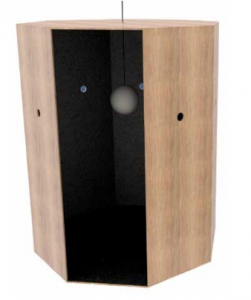
- For the construction of the Moon Box you can follow this resource (link).
- Torch
- Black Cardboard
- White pencils
- Optional: tactile moon phase model to be glued under the holes to allow tactile exploration, over and above visual exploration. Tactile models can be realized with a 3D printer (link) or simple materials (e.g., sandpaper) which can be felt by the hands.
Preparation of the Activity
The Moon Box is a wooden box with an octagonal base, which contains a reproduction of the Moon made with a 3D printer, fixed at the top with a thin fishing line so as to appear suspended, and only visible through eight small holes along the eight faces/walls of the poyhedron. The Moon Box can be easily built with common materials, for instance a large cardboard box and a white polystyrene ball hanging by a thread, as in Figure 1. For schools that want to try their hand at digital manufacturing, there is a version of the box which can be built with a 3D printer and a few other simple materials. You can find the whole description and the files here.
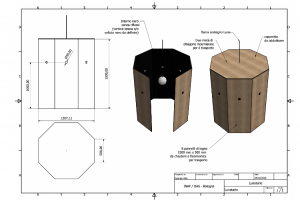
For the construction of the tactile Moon, you can use a 3D printer and the files here. As an alternative, you can create simple materials, such as sandpaper, which can be recognised by touching. Tactile moons can be glued outside the Moon box, above or underneath the hole from which the Moon phases are observed.
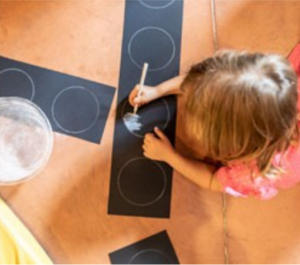
Moreover, it is useful to prepare black cards zigzag folded in eight, so as to allow participants to draw the Moon phases in the appropriate spaces.
Progress of the Activity
Start the activity like a game, by asking participants what the Moon looks like when they observe the sky at night, whether it appears always the same, what changes, whether the Moon is always there or whether sometimes they cannot see. Ask them why, according to them, the Moon changes its appearance and cannot always be seen. The initial part of this exchange of ideas can be guided, mainly for younger participants, by reading a picture book, such as “The Moon Man” by Tomi Ungerer or “The time the Moon and the Earth had an argument” by David Duff.
Then participants will be encouraged to test their hypotheses by using the Moon box. The facilitator holds a flashlight, which represents the Sun, resting on one of the holes. The children are invited to watch by peepholes in turns, progressively changing position around the Moon Box: as a result, the shape of the Moon, although always the same, changes in everyone’s eyes, according to the relative position between the source of light (Sun/flashlight) and the observer’s position. The facilitation of this phase was based on play, and sharing this discovery among peers. If you have also realized tactile Moons, you can encourage participants not only to watch through the holes, but also to touch the models applied near the holes.

In the final phase of the activity, participants are invited to reproduce the Moon phases, with black cards and white pencils. The facilitator may ask them to draw a Moon phase, in each face of the zig-zag cut card. If participants do not remember a phase, they can watch once again through the peepholes of the Moon box. For younger participants, this more reflective and abstract stage can be complex. In these cases, it may be carried out “life drawings”, with an eye on the Moon Box and an eye on the drawing, namely by drawing while observing through the hole of the Moon Box.
You can expand the activity by changing the position of the Sun (flashlight) and asking participants to reflect on what is happening. Check once again one’s ideas through the observation by the peepholes of the Moon Box.
Complete the activity by asking once again participants the questions initially made (what the Moon looks like in the sky and why). Use the experience you have made with the Moon Box and the drawings produced by participants to answer such questions.
If deemed useful, other “physical” experiences can be made by interacting in a darkened room with an inflatable ball (which represents the Earth), a flashlight (representing the Sun) and a small white polystyrene ball (the Moon).
Description of physical processes
“Moon phases” are changes in the aspect of the Moon, which can be seen from the Earth. These changes are repeated every month within an interval called “synodic month” which lasts 29,5 days, namely the time necessary for the Moon to complete a cycle from a full Moon to the next. This corresponds to its period of revolution around the Earth.
The Moon does not shine of its own light, but reflects that of the Sun. One half of the Moon is always lit by the Sun, whereas the other half is in shadow. From the Earth we always see the same face of the Moon Terra since, over and above rotating around the Earth, the Moon also rotates on itself (rotational motion).
The enlightened part of the Moon is the one facing the Sun, but the aspect of the Moon changes from the Earth, according to its position along its orbit. Therefore, the illuminated face of the Moon is not always visible from the Earth.
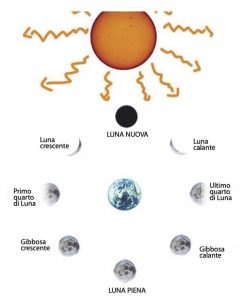
First phase: New Moon
When the Moon is aligned between Sun and Eaarth, is called New Moon, which marks the beginning of the lunar cycle. During New Moon, we see the face which is not illuminated by the Moon, therefore we do not see the Moon in the sky because of the luminosity of the Sun. If the alignment is perfect, a solar eclipse occurs.
Second phase: Waxing Moon
The Moon moves eastward and becomes progressively more visible from the Earth Terra. At first, it appears as a small segment which grows up to the first quarter of the Moon. In this phase, known as “waxing”, in the northern hemisphere the right part of the lunar disk is enlightened, whereas in the southern hemisphere the left part is enlightened.
Third phase: Full Moon
The Moon continues its orbital path and, when the Earth is between the Sun and the Moon, we see the whole face of the Moon illuminated: this is the Full Moon.
Fourth phase/u>: Waning Moon
The “waning” phase starts in the second half of the month: the illuminated part progressively decreases, retracing the shapes seen before the Full Moon with its hump pointing in the opposite direction. In the northern hemisphere, we will see the illuminated part on the left.