Teaching activity planned by Emanuele Dondoglio during the PhD course “Designing innovative public engagement activities”, held in 2022 at the University of Padua.
Materials
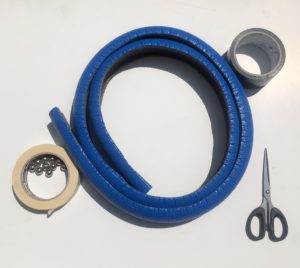
- 2 m long sponge tubes, cut in half, for insulation (3 for each group)
- scissors (1 for each group)
- black tape (1 for each group)
- marbles (4 for each group)
- container (1 for each group)
- wall (to attach the track to)
Description of the activity
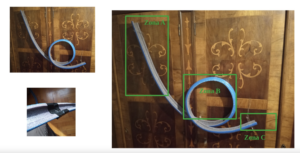
In this activity, you will have to challenge children to build a roller coaster for marbles, by rolling them on tubes, which you will need to cut in half lengthways before starting the activity. Divides the children into groups of 3-4. Each group will build a roller coaster for marbles, by gluing the pipes to the wall with adhesive tape, thus exploiting the force of gravity that makes the marble roll downwards to complete the route. The tubes can (and should) must be bent in various ways (see the Figure top left) and joint to form longer tubes (see Figure below left). Between two joint tubes, the tape must adhere to the tube, otherwise it brakes (or even stops) the marble. Each group has three tubes available (but the group can use fewer tubes, it’s up to them).
Each group is challenged to build a track, which meets two demands: first of all, the marble must be able to make a complete revolution (or loop); secondly, at the end of the route, the marble should land inside a container, which the children will have to understand where to place. You can give them a time limit to complete the challenge, for example 15-20 minutes. At the end, the groups test their tracks, to find out whether the marbles can follow the path. This might be a good time to explain some of the physics behind it, for example why the marble in their tracks passes (or does not pass) the loop; or why a marble lands in the container closer or further away when it leaves the track (see next section). At this point, you can challenge the group to build even more complicated roller coasters (for example: double loop, hills, curves…) letting them use their imagination. Staying attached to the wall is not a rule: a track starting from the wall may break away to make a curve.
Explanation of the physical process
The marble goes on, and manages to get to the end of its track, thanks to the force of gravity. Gravity acts on all the bodies we see everyday; in this case, it is always directed vertically downwards. It will have different effects according to the area of the track the marble is going through. In the large Figure on the right three different areas are highlighted:
Initial fall (zone A) In this zone, gravity pushes the marble to roll downwards, thus “helping” it move along the track. The longer this part of the path, the higher the marble’s speed at the end of the track. This happens because downhill the force of gravity accelerates the marble, so that the longer this part of the track, the more time gravity has in order to increase its speed. It i salso interestng to note the effects of the tube’s inclination: the nearer it is to a vertical position, the higher will be the speed at the end of the initial descent, the less time the marble will take to reach the end of this zone.
Loop (zone B) The start of the loop is characterized by a climb, where gravity decelerates (i.e. decreases) the marble’s speed, unlike the previous section. If the marble has not enough speed at the start of this phase, it will not go over the climb. Around the highest point of the loop, gravity tends to detach the marble from the path, because it is “upside down”, without a support underneath avoiding a freefall downwards. In order to prevent this, we use the centrifugal force, which acts upon each rotating body (like the marble in the loop), giving a push opposite to the force of gravity. The faster a body rotates, the higher the centrifugal force, therefore the greater its resistance to fall. In order not to fall, the marble must be fast enough to have a centrifugal force higher than the force of gravity, therefore, once again, it should have a rather high speed from the of the loop. At the end, the marble is in a situation similar to zone A, since it is going downhill, thus it will be once again accelerated.
End of track and landing (zone C) When the marble leaves the track and no longer has a support underneath, gravity pulls her vertically down. However, if in that moment it has a certain speed, it will not fall vertically: rather, it will also move in the direction of launch, while it falls down, in a round shape (the so-called parabolic motion), due to the combination of gravity and the push given to the marble.
How far does the marble land? The faster the marble, the higher the push in the direction in which it is launched (i. e. to the right for the track in Figure), therefore it will land further away. The inclination of the last stretch of track covered is also quite important. Indeed, the distance will be higher if the track makes a small ramp, that is a final climb, as in Figure, whereas it will be lower if the end of the track is downhill. However, be careful: if ramp is too much of a climb, the marble will go very high but land not far away. The maximum distance reached by the marble launched from the ramp (known as range) is reached by inclining the ramp by 45° (i.e. halfway between horizontal and vertical tube).