
These are the stars you can choose to send your message towards in the There’s Mail for E.T. competition. They were selected based on their position (they must be visible” from Italy, where the transmitting antenna is located), their distance (not too far away), and the presence of planets orbiting within the habitable zone, the region around a star where liquid water could exist. By clicking on the images, you can access a NASA page with all the information about the planet and the planetary system associated with each star.
More generally, if you are passionate about exoplanets, NASA’s Eyes on Exoplanets page shows all those confirmed so far in our galaxy, the Milky Way. As of March 2026, there are 6,153, distributed across 4,585 different planetary systems.
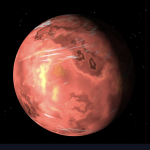 |
Ross 128 is a red dwarf hosting Ross 128 b, a rocky exoplanet in the habitable zone. With its close orbit and potentially temperate climate, it is considered one of the most promising candidates in the search for life, partly thanks to its distance of just 11 light-years, which makes it one of the closest planets to Earth. On the left, an artist’s impression of Ross 128 b. |
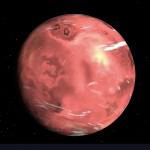 |
GJ 411, also known as Lalande 21185, is a red dwarf only about 8 light-years away, which makes it one of the closest planetary systems to the Sun. It hosts GJ 411 b, a rocky super-Earth on a 13-day orbit, too close and too hot for liquid water, and GJ 411 c, a Neptune-like planet on a much wider orbit lasting almost eight years. A third planet may lie between them. Its habitable zone is one of the few that future space telescopes will be able to observe directly, in search of rocky planets not yet discovered. On the left, an artist’s impression of GJ 411 b. |
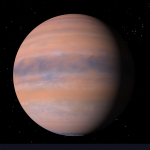 |
GJ 357 is a red dwarf about 31 light-years away, orbited by three confirmed planets. One of them, GJ 357 d, lies in the habitable zone and could have temperate conditions and liquid water, if it has a thick enough atmosphere. The two inner planets are much hotter, in a compact system with the close orbits typical of red dwarfs. On the left, an artist’s impression of GJ 357 d. |
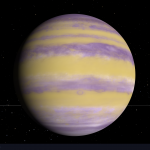 |
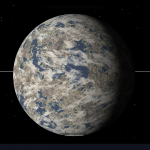
GJ 414 is a binary system about 39 light-years away, in the constellation Ursa Major, made up of an orange dwarf, GJ 414 A, and a smaller red dwarf, GJ 414 B. Two planets orbit the main star. GJ 414 A b, a sub-Neptune several times more massive than Earth, follows an elongated orbit that brings it close to the inner edge of the habitable zone. GJ 414 A c, a planet with a mass similar to Saturn’s, orbits much farther out in about two years and is very cold. The two planets lie on either side of the habitable zone, and the outer one is a promising target for future telescopes able to photograph exoplanets directly. On the left, an artist’s impression of GJ 414 A b.
|
 |
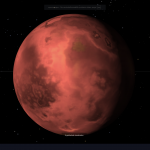
TRAPPIST-1 is an ultracool red dwarf about 40 light-years away, hosting seven rocky, Earth-sized planets, three of which (e, f and g) lie in the habitable zone. Because the star is so small and cool, the system is very compact: all seven planets complete their orbits in between one and a half and about 19 days. Their closeness to the star, their remarkable chain of orbital resonances and the fact that they pass in front of their star as seen from Earth make them ideal targets for studying their atmospheres and searching for water, as the James Webb Space Telescope is already doing. On the left, an artist’s impression of TRAPPIST-1 e. |
 |
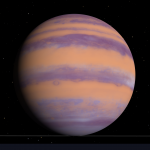
GJ 3473 is a red dwarf about 90 light-years away, orbited by two known planets. GJ 3473 b, slightly larger than Earth and almost twice as massive, completes an orbit in just over a day: it is one of the hottest Earth-sized planets known. Because it passes in front of its star as seen from Earth, it is an excellent target for studying the heat it emits and, with it, the nature of its surface and possible atmosphere. Farther out, GJ 3473 c, at least seven times more massive than Earth, orbits in about 15 days and is much more temperate. On the left, an artist’s impression of GJ 3473 b. |
 |
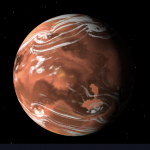
TOI-1266 is a red dwarf about 120 light-years away, orbited by three planets. The two inner ones, discovered by NASA’s TESS satellite using the transit method, are slightly larger than Earth but much less dense: TOI-1266 b probably has a thick gaseous envelope, while TOI-1266 c could be a world rich in water. Unusually, the larger planet orbits closer to the star than the smaller one. TOI-1266 c receives about as much light as Venus does from the Sun, while the third planet, TOI-1266 d, recently confirmed, orbits farther out and could have more temperate conditions. On the left, an artist’s impression of TOI-1266 c. |
 |
K2-72 is a red dwarf about 217 light-years away, in the constellation Aquarius, orbited by four small planets, all probably rocky and only slightly larger than Earth. They were discovered by NASA’s Kepler space telescope during its K2 mission. Because the star is small and dim, its habitable zone lies very close to it: K2-72 e, the outermost planet, completes an orbit in just 24 days, yet receives an amount of energy similar to Earth’s and lies within the habitable zone, where liquid water could exist on its surface. On the left, an artist’s impression of K2-72 e. |
 |
K2-9 is a red dwarf about 270 light-years away, orbited by one known planet, K2-9 b, discovered by NASA’s Kepler space telescope during its K2 mission. The planet completes an orbit in about 18 days and, because the star is small and dim, receives an amount of energy similar to what Earth receives from the Sun. It is about twice the size of Earth: it could be a rocky super-Earth or a small gaseous “mini-Neptune”, and only a measurement of its mass will tell. The star emits a lot of ultraviolet radiation, which would strongly affect the chemistry of any atmosphere the planet might have. On the left, an artist’s impression of K2-9 b. |
 |
Kepler-1649 is a red dwarf about 300 light-years away, famous for its planet Kepler-1649 c, one of the most Earth-like exoplanets known in both size and temperature. Only slightly larger than Earth, it orbits in the habitable zone of its star, completing an orbit in about 19 days and receiving about three quarters of the light that Earth receives from the Sun. It was discovered in 2020 by scientists re-examining data from NASA’s Kepler space telescope: the automatic software had mistakenly discarded its signal. The system also contains a second, inner planet, Kepler-1649 b, which is similar in size to Earth but much hotter, more like Venus. On the left, an artist’s impression of Kepler-1649 c. |
 |
Kepler-296 is a system of two red dwarfs about 720 light-years away, in the constellation Draco, so close together in the sky that they cannot be told apart in ordinary images. Five planets were discovered there by NASA’s Kepler space telescope, and for a long time astronomers could not tell which of the two stars they orbited. Detailed analysis later showed that all five orbit the brighter star, Kepler-296 A. The two outermost planets, Kepler-296 e and Kepler-296 f, are about one and a half to two times the size of Earth and lie within or close to the habitable zone, where liquid water could exist. On the left, an artist’s impression of Kepler-296 e. |
 |
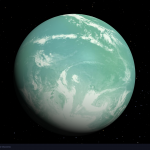
Kepler-186 is a red dwarf about 580 light-years away, in the constellation Cygnus, orbited by five planets that are probably rocky. The outermost, Kepler-186 f, was the first Earth-sized planet ever found in the habitable zone of another star, announced in 2014 from data collected by NASA’s Kepler space telescope. It is only about 10% larger than Earth and completes an orbit in about 130 days. Located near the outer edge of the habitable zone, it receives about a third of the energy Earth gets from the Sun: liquid water could exist on its surface if its atmosphere retains enough heat. On the left, an artist’s impression of Kepler-186 f. |
 |
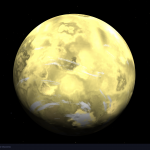
Kepler-22 is a star very similar to the Sun, about 640 light-years away, in the constellation Cygnus. In 2011 it became famous for its planet Kepler-22 b, the first planet discovered by NASA’s Kepler space telescope in the habitable zone of a Sun-like star. Kepler-22 b is about 2.4 times the size of Earth and completes an orbit in about 290 days, a “year” not very different from ours. Its mass is not yet known, so we do not know whether it is a rocky super-Earth, an ocean world or a small gaseous planet similar to Neptune. Its discovery boosted the search for temperate planets around stars like our Sun. On the left, an artist’s impression of Kepler-22 b. |
 |
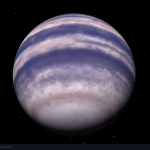
Kepler-1229 is a red dwarf about 870 light-years away, in the constellation Cygnus, orbited by one known planet, Kepler-1229 b. This super-Earth, about 1.4 times the size of Earth and probably rocky, completes an orbit in about 87 days and lies within the habitable zone of its star. It receives about a third of the energy that Earth gets from the Sun, so liquid water could exist on its surface only if its atmosphere retains enough heat. It was announced in 2016, together with more than 1,200 other planets confirmed by NASA’s Kepler space telescope. On the left, an artist’s impression of Kepler-1229 b. |
 |
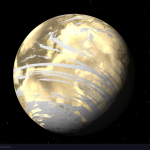
Kepler-705 is a red dwarf about 820 light-years away, orbited by one known planet, Kepler-705 b, confirmed in 2016 from data collected by NASA’s Kepler space telescope. The planet is about twice the size of Earth and completes an orbit in about 56 days. It receives about two thirds of the energy Earth gets from the Sun, which places it within the broader, “optimistic” definition of the habitable zone. With a size halfway between rocky super-Earths and small gaseous planets, it could be either: only a measurement of its mass will tell. On the left, an artist’s impression of Kepler-705 b. |
 |
Kepler-62 is an orange dwarf, slightly smaller and cooler than the Sun, about 1,000 light-years away in the constellation Lyra. It hosts five confirmed planets, discovered by NASA’s Kepler space telescope and announced in 2013. Two of them, Kepler-62 e and Kepler-62 f, are super-Earths, about one and a half times the size of Earth, and lie within the habitable zone. Kepler-62 e receives slightly more energy than Earth, while Kepler-62 f, which completes an orbit in about 267 days, receives less than half: both could host liquid water, depending on their atmospheres. The system shows that stars other than the Sun can host planets similar to Earth. On the left, an artist’s impression of Kepler-62 f. |