Skip to content
Play
Play
Primary Navigation Menu
Menu
  • Home
  • Resources
    • Coding
    • Educational Robotics
    • Making
    • Tinkering
    • Games
  • Educational Path
  • Blog
  • English
    • English
    • Français
    • Italiano
    • Deutsch

Learners

This is a collection of activities that can be carried out by students, in class or at home, in complete autonomy.

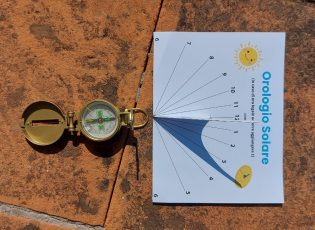
Lets build a sundial
2025-12-14
By Rachele Toniolo
On 14 December 2025

With this activity you can quickly build your own paper  sundial and find out what time it is by using the Sun! The performance is better if the watch pattern is printed on a cardboard. As an alternative, you can print it on normal paper and glue the sheet on a cardboard, or a file folder, before cutting and assembling. Necessary Materials Copy of the sheet Sundial (better if printed on cardboard) Scissors Tape (Scotch tape) (optional) file folder (optional) glue stick What to do and how to observe ReadLEGGI TUTTO
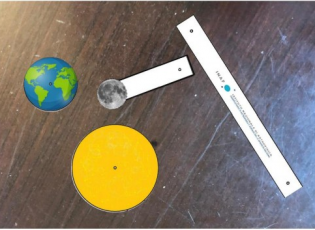
Sun-Earth-Moon

2025-12-14
By Rachele Toniolo
On 14 December 2025

This simple activity, designed for pre-school children, or children in the early years of primary school, allows us to bring the little ones closer to understanding the motions of familiar celestial bodies, such as the Sun, the Earth and the Moon. Through the construction of a bidimensional model (2D), not to scale, children will be able to familiarize with the movements of the Moon around the Earth, and of the Earth around the Sun, making learning these concepts more concrete and fun. The yield is better if the Sun-Earth-Moon model isLEGGI TUTTO

Senza categoria

The Moon Box

2025-12-12
By Rachele Toniolo
On 12 December 2025

Short description of the Activity Source of marvel for everyone, the Moon never stops bewitching and being the protagonist of incredible stories. But why does a crescent Moon sometimes appear to us, and sometimes a full Moon, and every now and then you cannot even see it? Thanks to the Moon Box you will discover why the Moon appears always different. You will find out the secrets of its appearing and disappearing, and keeps surprising with its cyclical change. Materials for the activity For the construction of the Moon BoxLEGGI TUTTO

Senza categoria

The Milky Way at your Fingertips

2025-12-12
By Rachele Toniolo
On 12 December 2025

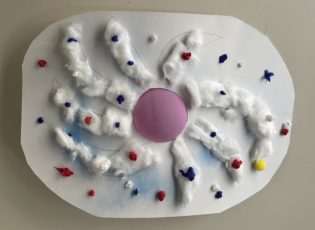
Teaching activity planned by Edoardo Ceccarelli, Giulia Campitiello and Stefano Sotira during the PhD course “ Designing innovative public engagement activities” at the University of Bologna in 2023. Short description of the activity: The Universe is mainly composed of a series of structures which are called galaxies, of various shape and kind. The galaxy in which we live, or hosts our Solar System, is called Milky Way and is one of the many spiral galaxies. The name of this category of objects derives from the particular distribution of gas inside,LEGGI TUTTO

Hands-on

This Universe is a Chaos!

2025-03-12
By Rachele Toniolo
On 12 March 2025

Teaching Activity planned by Irene Salmaso and Biagio Ambrosio during the PhD course “Designing innovative public engagement activities”, held at the University of Padua in 2024. Short Description of the Activity What does entropy mean, and how does it work? In this experience, through the use of colours and smells, it will be possible to perceive the different degrees of entropy which exist in more or less disorderly systems, in order to discover how it evolves with time. Materials Blue, red and yellow poster paints 3 food flavourings/different recognizable essentialLEGGI TUTTO

Hands-on

Pulsars too miss a beat

2025-01-22
By Rachele Toniolo
On 22 January 2025

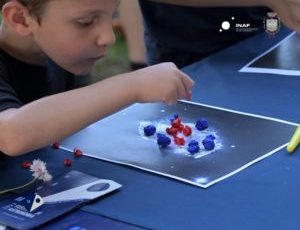
Teaching activity planned by Leonardo De Deo, Greta Toni and Rachele Toniolo during the PhD course “Designing innovative public engagement activities” held at the University of Padova in 2024. Short description of the Activity Did you know that in the Universe there are objects behaving like clocks? We are talking about pulsars, peculiar stars emitting light pulses with an extremely precise rhythm. However, even the best sometimes miss a beat. In this laboratory, we will play with pulsars and their rhythm, and will discoverir how they are used to studyLEGGI TUTTO

Hands-on

Never ask a galaxy for its Age!

2024-11-22
By Rachele Toniolo
On 22 November 2024

Teaching activity planned by Stefano Giarratana, Emanuele De Rubeis, Cristina Nanci, Xavier Lopez Lopez and Davide Pellicciari during the Phd course “Designing innovative public engagement activities” held at the University of Bologna in 2023. Short description of the activity: The galaxies which make up our Universe are of various types, each one with a different shape and features. The goals of this activity is discovering the main differences between two particular categories of galaxies: spiral galaxies and elliptical galaxies. Just like astronomers, we will find out which of the two containsLEGGI TUTTO

Mission Ariel: what’s the air like on exoplanets?

2024-03-13
By Laura Leonardi
On 13 March 2024

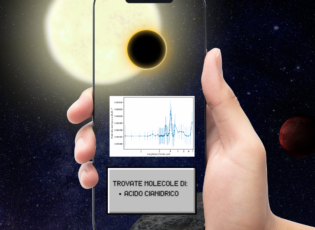
  Ariel is a mission of the European Space Agency, whose launch is scheduled in 2029 and devoted to studying the atmospheres of extrasolar planets, namely all those planets orbiting around stars similar or different from the Sun. Thanks to this space mission, for the first time it will be possible to carry on a systematic study of the properties and chemical composition of the atmosphere of these celestial bodies, to shed some light on the still obscure points about their formation and evolution. Italy is one of the 17 countries taking partLEGGI TUTTO

Coding

Pluto, the dwarf planet

2023-02-09
By Silvia Galleti
On 9 February 2023

Pluto is a dwarf planet placed in the Kuiper belt a doughnut-shaped region of icy bodies beyond the orbit of Neptune. Discovered in 1930, Pluto has long been considered the ninth planet of our Solar System. However, after the discovery of similar worlds in the Kuiper belt, it has been reclassified as dwarf planet. Pluto is smaller than the Moon, and lies about 5,8 billions km from the Sun. It has a thin atmosphere, mainly composed of nitrogen, methane and carbon monoxide. On average, the temperature of Pluto is -232°C, andLEGGI TUTTO

Coding

Neptune, the slowest planest

2022-01-25
By Rachele Toniolo
On 25 January 2022

Netpune is  the last planet of the Solar System in order of distance from the Sun. It takes Neptune almost 165 years to travel along an orbit around our star, and a little more than 16 hours to complete one full turn around itself. The picture on the right – taken by the Voyager 2 probe in 1989 – shows the presence of the Big Dark Spot, a system of storms with an average diametre of 14.000 km, which represents one of the largest atmospheric structures of the Solar System, afterLEGGI TUTTO

Coding

Saturn, the Lord of rings

2022-01-25
By Rachele Toniolo
On 25 January 2022

Saturn is the sixth planet of the Solar System in order of distance from the Sun and can be easily recognized by the series of rings surrounding it, mainly composed of principalmente da ice and dust. Saturn is classified as a gaseous planet, i.e. mainly composed of gas. Just like Jupiter,  its atmosphere is lashed by continuous winds, which can even reach 1800 km/h. In its North Pole there is a particular nebula called Saturn’s Exagon, which rotates around the central vortex of the North Pole. A unique feature in the whole Solar System!LEGGI TUTTO

Coding

Jupiter, the gaseous giant

2022-01-24
By Rachele Toniolo
On 24 January 2022

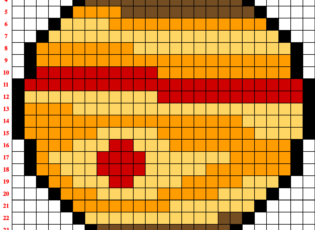
Jupiter is the fifth planet of the Solar System  in order of distance from the Sun, and the largest of the whole Solar System: its mass is twice and a half the sum of the masses of all the other planets together! Jupiter is classified as a gaseous planet, namely mainly composed of gas. Its huge atmosphere is characterized by several bands, inside which we can observe the presence of numerous storms. Among them, the Big Red Spot stands out, an anticyclonic storms which has been going on for at least 300 years! HereLEGGI TUTTO

Posts pagination

1 2 … 4 Next

PLAY INAF

By the INAF innovative teaching group. Translations into English, French, and German are by Giuliana Giobbi.

PLAY INAF sui social

Designed using Chromatic Premium. Powered by WordPress.